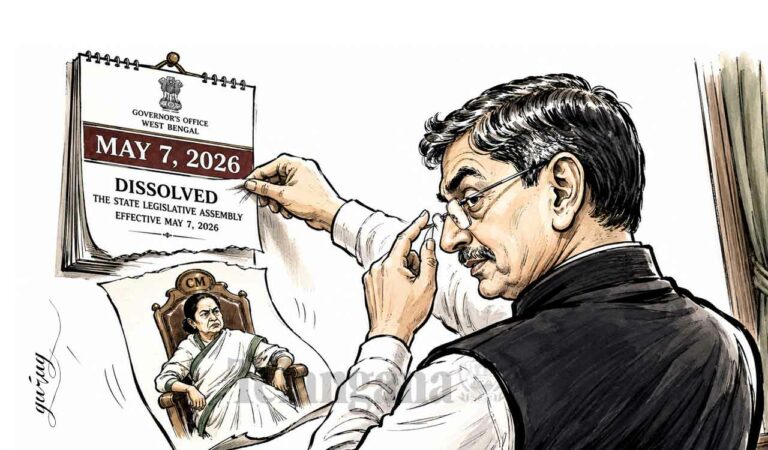
The concerns over the Special Intensive Revision (SIR) of the electoral rolls and its impact on the recently held Assembly elections in West Bengal may be genuine, but they should not be used as a political weapon to create a constitutional impasse. Unfortunately, Chief Minister Mamata Banerjee’s antics have the potential to create a constitutional crisis. Her refusal to resign despite the defeat of her Trinamool Congress at the hands of the BJP, citing manipulation of the poll results, is quite unbecoming of those occupying high public offices. Never in the history of independent India has any Chief Minister declined to step down following an electoral defeat. In a democracy, public mandate is supreme and must be respected by all. Smooth transfer of power following free and fair elections has been the strength of Indian democracy. By describing the poll outcome as a ‘black day’, refusing to step down by invoking conspiracy theories and daring the Centre to impose President’s Rule in the State, Banerjee has pushed the narrative of defiance a bit too far. Her public outbursts soon after the declaration of results sounded similar to Donald Trump’s claim in 2021 that the US Presidential Elections were stolen. She alleged that the Election Commission was hand-in-glove with the BJP in manipulating the results in over 100 constituencies. The firebrand TMC leader would be well advised to explore legal options to clear the air regarding the poll process, instead of creating obstacles in the path of the constitutional process.
As per the Constitution, a Chief Minister must have the support of the majority in the Assembly. With the BJP winning 207 seats in the 294-member House and the TMC reduced to 80, the present government cannot continue. While there is no explicit provision in the Constitution requiring a Chief Minister to resign after losing an election, constitutional propriety and conventions entail such a move to pave the way for a peaceful transfer of power. If the CM refuses to step down even after electoral defeat, then the Governor has certain measures at his disposal, including recommending President’s Rule as the last resort. Under Article 164(1) of the Constitution, chief ministers and their cabinets are said to hold office “during the pleasure of the Governor”, which indicates the latter can dismiss them. According to constitutional provisions, the Governor can demand Banerjee’s resignation or wait for her term to expire, after which newly elected lawmakers would be sworn in. A defeated candidate in a State election can challenge the result in court. However, the Supreme Court has consistently held that an election petition challenging a result does not automatically stay that result, and governance cannot be held hostage to unresolved petitions. The questions regarding the constitutionality of the SIR exercise — which is at the heart of the present controversy — must be left to the apex court to decide.